Posts

A New Flower in the Calvinism/Arminianism Debate

Image
Francisco Marín-Sola advances an innovative alternative in the free will/determinism debate in the book, Do Not Resist the Spirit's Call: Francisco Marín-Sola on Sufficient Grace.  He claims his view is Thomism, and I certainly don’t deny that it could be a type of Thomism, though other Thomists like Lagrange are far more determinist than Marín-Sola.  In the spectrum, I would place it here: Since many theological systems have a flower acronym (TULIP, ROSES, DAISY, POINSETTIA…) I figured I would give Marín-Sola’s system the LOTUS. Lotus Laps of Man Foreknown but not Caused by God.   God foreknows the fall, but He does not cause it.  Man is the first cause of all sins. -  While all but Open Theists would agree the fall was foreknown, likely Calvinists and Thomists would object to the idea that man is the first cause of sin or anything else for that matter. Only by Grace.  God provides sufficient grace for all, which is a physica...
Response to Nathanael Taylor on Molinism

Nathanael P. Taylor is posting a series on Molinism ( link ) Here’s his description of Molinism. In Molinism, it’s been true through all eternity past that if I were in a circumstance C, then I would have faith in Christ. Logically, this means that it was true prior to God choosing to create this actual world. However, this just happens to be true—it is a contingent truth. In other words, something different could have been true from all eternity past. The counterfactual that if I were in a circumstance then I would have faith in Christ could have either been truth or false. Suppose this counterfactual statement turned out true—you might ask, “What makes this counterfactual true or false?” And the answer is that nothing makes it true. The counterfactuals of creaturely freedom are just true from all eternity past and, oddly, nothing makes them true. God can’t make them true because that would mean God has control over the counterfactuals of creaturely freedom, resembling Calvinism....

Molinism and God's Infallible Plan

Image
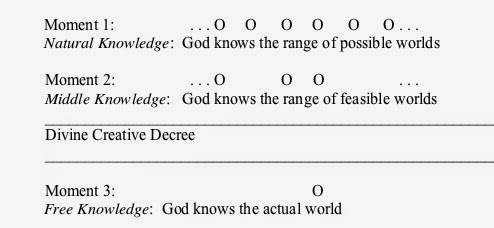
Turretinfan recently posted on Dr. Anderson’s argument that on Molinism God’s decrees are fallible, because we can choose otherwise than God decrees. ( link to Turretinfan’s post ; link to Dr. Anderson’s post ).  But Dr. Craig pointed out that if the person would have chosen otherwise, God’s decrees would have been different.  Dr. Anderson then called this solution a “special pleading” and argued Molinists should not be allowed to exclude God’s decree.  His supporting reasons were 1) God’s decree implies we will not do otherwise (he called this a relative logical necessity) and 2) God’s decree has causal consequences.  Turretinfan accepts Dr. Anderson’s arguments and adds that sometimes prophesies are self-fulfilling (i.e. a prophesied victory motivates troops to fight).     This is a complex business but fortunately the answer is simple.  Here’s a chart explaining Molinism: Dr. Ande...

Response to James White on Middle Knowledge

James White recently discussed middle knowledge on the Dividing Line.  Here's an audio response:  Link

James Anderson on Calvinism and the First Sin

James Anderson was kind enough to share a chapter of an upcoming book he’s working on.  ( link )  The chapter is titled Calvinism and the First Sin and the book will be titled Calvinism and the Problem of Evil.  Dr. Anderson will remove the online version once the book is published, so read it while you can. Dr. Anderson addresses the challenges unique to Calvinism regarding the problem of evil including: 1) God’s determining the first sin makes Him the author of sin, 2) Calvinists must be compatiblists and there are some fairly strong arguments against compatibilism, and 3) and given Adam’s good nature, there’s no causal explanation for the first sin.  To his credit, Dr. Anderson openly embraces the idea that Calvinism is indeed divine determinism.  Now in true Van Tillian fashion, he spends a great deal of time explaining what this does not mean without elaborating on what it does mean.  Dr. Anderson argues that Calvinists need not be causal dete...

Pope says "Who am I to judge Gays?"

Thought this was coming, but it was quicker than I would have guessed.  This will of course lead to corruption in society, but also to the purification of Christ's Church, as many will now see their choice is between their Pope and God's word. http://www.huffingtonpost.com/2013/07/29/pope-francis-gays_n_3669635.html

Book Review - Jacob Arminius: Theologian of Grace by Keith Stanglin and Thomas McCall

The book begins with a brief but helpful account of the life and times of Jacob Arminius, but points readers to Bangs work for a more detailed biography (Bangs, Carl.  Arminius – A Study in the Dutch Reformation.  Wipf & Stock Publishers, 1998).  Then it dives into the foundation of Arminius’ theology - his explanations of God’s attributes.  On the simplicity of God, Aquinas taught God’s attributes are distinct only in the way we think about them, but are really united in God, but Arminius disagreed and rather followed John Dun Scottus who taught God’s attributes really are distinct in God even though they are absolutely inseparable.   On omniscience, Arminius followed Luis De Molina in affirming middle knowledge – and this book is the first I have seen to acknowledge that Arminius’ view of predestination is based on God’s middle knowledge of faith rather than so called simple foreknowledge.  Then in a rare low point in the book - Arminius is accus...